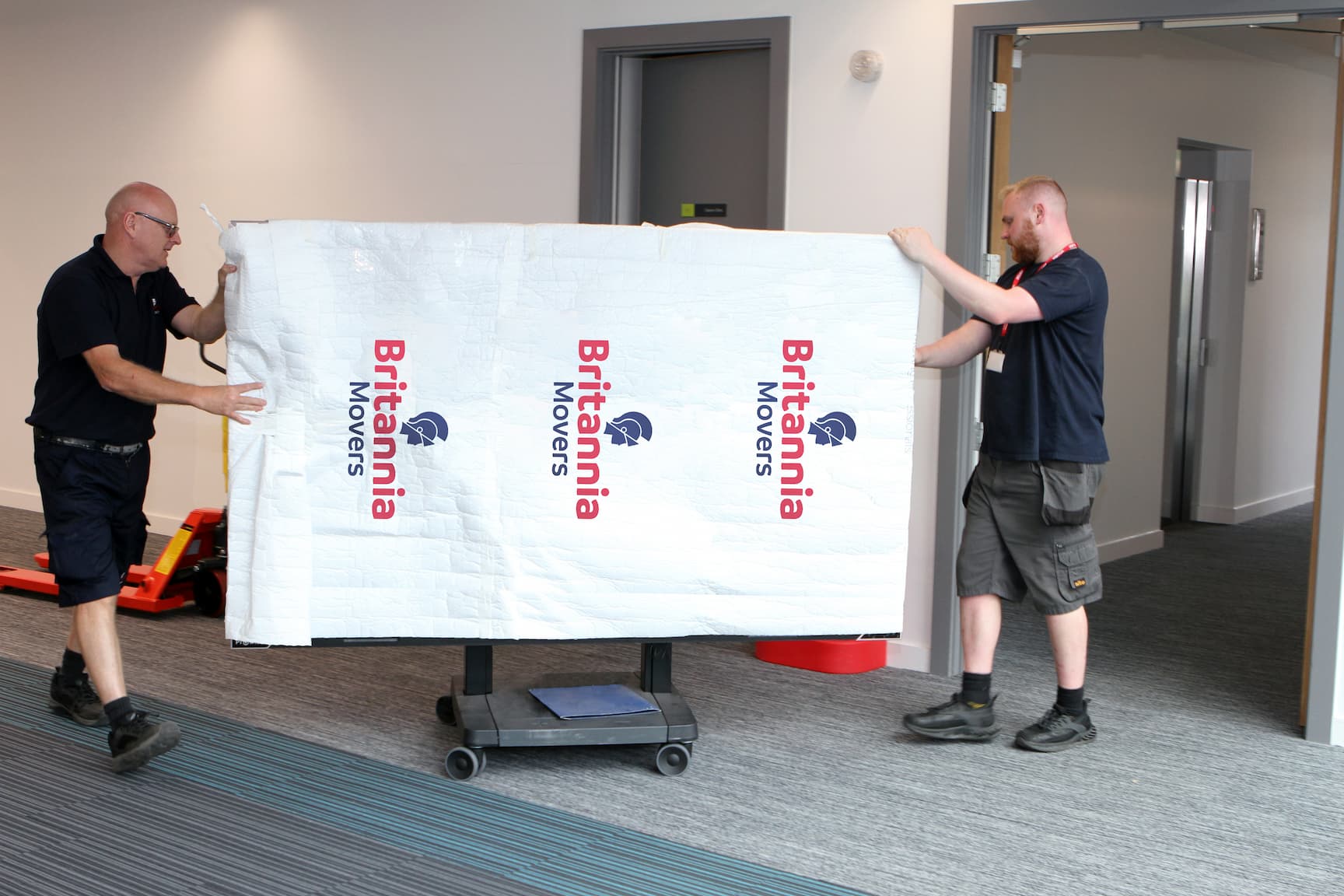
Britannia has active links with insurance companies and loss adjusters across the UK, which is usually the part that matters most in the first day. After a flood, a fire or a burst pipe, the argument about who pays comes later. What happens immediately is that undamaged contents are sitting in a building that is now wet, contaminated or about to be stripped out by a drying contractor. Anything left in there gets worse.
Recovery removals are a specialised strand of the trade and Britannia Cestrian has run them from the Deeside depot alongside ordinary household work for decades. This covers homes and business premises across Chester, the Wirral and North Wales.
A typical job of this kind
| Service | Disaster recovery removals and storage |
| Typical trigger | Flood, fire, burst pipe or storm damage |
| Who it is for | Homeowners and businesses |
| What we do | Remove salvageable contents from damaged areas, store securely, return when repairs finish |
| Working with | Insurance companies and loss adjusters |
| Storage | Secure containers at the depot, with the Britannia network behind it |
Getting contents out of the damaged area
The first job is separating what can be saved from what cannot, and getting the first group out of the building. We remove furniture and other goods from the damaged areas so that drying, stripping out and repair work can start without everything you own sitting in the middle of it.
For a business that usually means stock, equipment, IT and records. For a home it means furniture and the contents of the rooms that took the damage.
Straight into secure storage
Contents go into a secure storage facility and stay there until repairs are complete. At the Deeside depot that means the same warehouse used for household storage, monitored inside and out by 24-hour CCTV, behind a secure perimeter fence with an alarm system.
Where the volume or the location makes it more sensible, Britannia’s network of branches means contents can be stored at whichever facility is best placed rather than whichever one happens to be nearest to us.
Working with your insurer and loss adjuster
Britannia has long-standing links with insurance companies and loss adjusters across the UK, and a long record on recovery removals. In practice that means the paperwork side is familiar rather than improvised. Inventories, condition records and storage arrangements are the things a claim later turns on, and they are produced as part of the job rather than reconstructed afterwards.
Back in when the building is ready
When repairs are finished, the contents come back and are placed. For a business that can be phased so that the parts needed to trade come back first. The storage term runs as long as the repair does, which is rarely the length anyone estimated at the start.
What to do before we arrive
Photograph everything before anything moves, including the damage and the room as a whole. Tell your insurer you intend to remove salvageable contents. Do not throw anything away until the loss adjuster has seen it, however obviously ruined it looks, because disposal before assessment causes more claim problems than any other single thing.
Then call us with the address and rough contents, and we will tell you what we can do and when.
Accreditations
- Member of the British Association of Removers
- Certified to BS EN 12522, the European standard for household furniture removal
- Which? Trusted Trader, with independently verified reviews
- Established 1972, and part of Britannia Movers International, a network of 49 family-run removal companies
Call about a recovery
Tell us the address, what has happened and roughly what needs sorting. Call 01244 521 950, email sales@britanniacestrian.co.uk, or use the contact page. The office is open Monday to Friday, 8.30am to 5pm.
Related pages
Disaster Recovery | Storage in Chester | Business Storage | Commercial Removals